Like most people, I believed I saw reality as it truly is. I didn’t question it. I didn’t know there was anything to question.
Then I came across something Joseph Jaworski said: “If we could only see reality more as it is, it would become obvious what we need to do.”
At first, it made little sense to me. But it stayed with me because it fascinated me and because of who said it. I had interviewed Joseph and attended his workshop. I had read his books and was deeply moved. There was something in his presence and his work that told me to explore it more deeply.
So I kept carrying the question: What does it mean to see reality as it is?
For years, I thought the answer would be more knowledge, better frameworks, sharper analysis and more experience. But that wasn’t it.
The shift came when I began to notice that I wasn’t seeing reality first. I was seeing my interpretation. I was seeing conditioning. I was seeing fear, memory, identity, preference, and judgment. And I was seeing the world through a lens I didn’t know was there.
That realization was stunning.
It changed how I saw leadership, transformation, conflict, communication, and now AI. Suddenly, so much of what had seemed confusing became obvious. Not because I had learned a better model, but because I could see what the old models kept missing.
We keep trying to solve problems downstream of the lens that makes them seem real. That has been the center of my work ever since.
And yet, there is something else I’m learning now. Seeing what others don’t yet see can become its own subtle trap.
It can become frustrating.
You point toward something deeper, and people look the other way. You share what now seems obvious, and most return to the same familiar conversations. Better tools. Better methods. Better strategies. Better words.
Same lens.
That frustration is understandable. But it is also revealing because the moment I make others wrong for not seeing, I have left the very clarity I am trying to share.
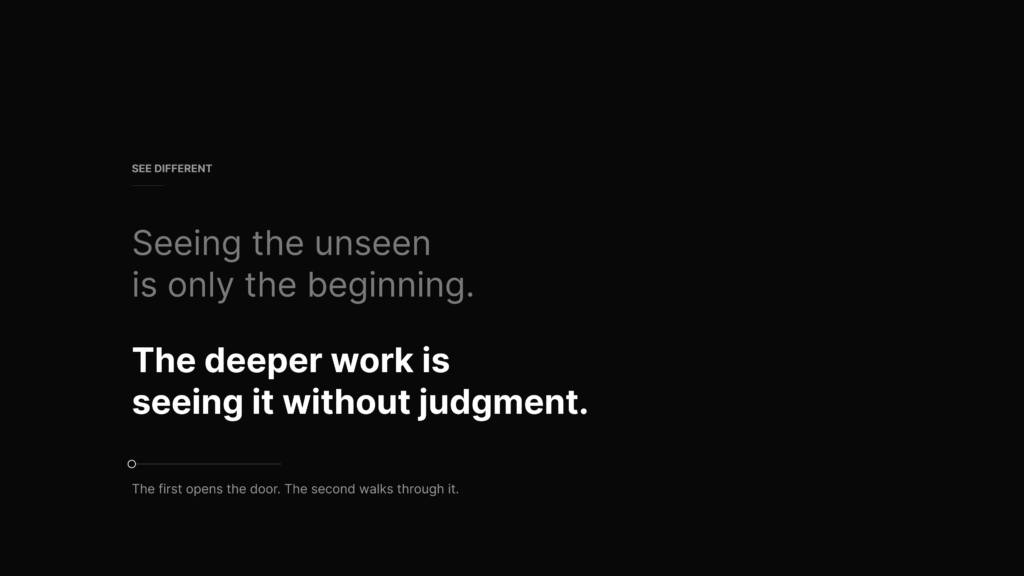
This is where the deeper lesson begins. The work is not only to see the lens. It is to see without judgment. To notice the unseen without turning it into superiority. To name the pattern without attacking the people inside it. To keep pointing upstream without creating another form of separation.
That may be the harder practice.
Many say we strengthen what we give attention to. Not only through desire, but through fear, resistance, and judgment. So if I look at the world and say, “No one sees this,” from frustration, I may be strengthening the very separation I want to dissolve.
But if I look with forgiveness, something different becomes possible. The message changes.
Not: “You’re missing what I see.” But: “There is something here we may not have learned to see yet.”
Not: “Everyone is downstream.” But: “Maybe the next opening is upstream.”
Not: “The perceiver is the problem.” But: “The lens can be seen, softened, and released.”
That is what I’m learning now. Seeing differently isn’t only a perception shift. It is a state of being. The clearer I see, the more responsible I become for the state I share from. Because every post carries more than an idea. It carries the state of mind that created it.
The real work may not be to convince others to see what I see. It may be to create from such stillness that something in them has room to see for itself.
That feels like the next layer. Not just seeing the unseen. It’s seeing it without losing peace.
— BF